Slate editor Jacob Weisberg has a sweet little essay today granting press credentials to anybody who wants to be a journalist. I totally agree with Weisberg’s sentiment, but I think he’s asking the wrong question — and I post this because I think a lot of “journalists” do.
“Who is a journalist?” strikes me as a fairly useless question, and not just since the arrival of the Internet. It seems to me we should be asking “what is journalism?”
Journalists derive the title exclusively from the function of journalism — not how good they are at it, not what institution they represent, not what stories they cover — but the bare fact of what they do. Judith Miller and Matt Cooper of Time can’t claim any special place in American democracy from the word “journalist” appearing under their names on their business cards.
But the acts of gathering information, synthesizing, and disseminating that information publicly in an essentially verifiable report — those acts, when done in tandem, can and should receive special protections, no matter the context in which they are performed.
It’s journalism, not journalists, we should be struggling to protect. I think we sometimes lose that distinction (hat tip to Rebecca MacKinnon, who might agree with me). Whether bloggers constitute journalists is abstract and immaterial. What in newspapers and on blogs and on television constitutes journalism, now, that strikes me as a provocative question.
Despite 1) appearing in the San Francisco Chronicle, and 2) being funny, this, I would argue, is not journalism. Haul Jon Carroll’s pajama-wearing ass into court and make him testify. This, however, strikes me as journalism. Others might quibble. But at least we’d have a good conversation.
Weisberg notes that bloggers are trying to have it both ways in terms of the law — the folks being sued by Apple want to be treated like journalists, while those in danger of being regulated by the FEC want to be considered something else. “A more consistent stance would be to assert that the First Amendment should apply equally to everyone who practices journalism,” Weisberg says, “Whenever and wherever they do it, and that political advocacy online should be treated consistently with advocacy offline.”
An even more consistent stance would be to assert that the First Amendment should apply equally to all acts of journalism, no matter the source.
I realize that since it has now appeared in Newsweek, Yellow Arrow is a) no longer cool and b) tired. But as NBC’s late-’90s summer rerun promotional department would say, “If you haven’t seen it, it’s New to You

The above graph shows how Americans would reallocate the federal budget if given the chance, according to a PIPA survey of 1,200 adults (PDF). Kevin Drum, who pointed this study out, warns social-spending-happy liberals to chill, because if they actually proposed cutting the defense budget by a third and spending all that cash on education and renewable energy, they would quickly discover the heat of this country’s fury.
It’s unfortunate that “space program” and “science research” are lumped together on this graph (and nowhere to be found in the accompanying PDF). Because clearly, if I’d gotten my grubby little hands on this survey, NASA would become the NAA, and its budget would be approximately $959 million.* And the National Science Foundation would find its budget mysteriously expanded by about, oh, $14.5 billion or so.
I mean, take this page and multiply its coolness factor by 4. Is your mind blown yet?
Speaking of the NSF, check out the Digital Promise Project, a foundation that wants to create a sort of NSF for education. Together with the New America Foundation, Digital Promise is pushing a piece of legislation that would use the money from selling and licensing the public airwaves to create a trust fund devoted to R&D in the field of education.
I’m inclined to think that’s pretty cool. Critics of the legislation launch their broadside with the question, “Must the government establish what amounts to a new Public Broadcasting System for the Internet?”
Pardon me, I seem to be drooling just ever so slightly.
* “National Aeronautics Administration.” None of this hoity-toity space crap. Leave that to Burt Rutan and Richard Branson.

I just got back from another conference on the future of news, where many cool thoughts were exchanged that will find their way to this blog in due time.
There, I got to chat briefly with Karen Stephenson, who gave a presentation on organizational trust structures. As Malcolm Gladwell describes her work:
Stephenson studies social networks. She goes into a company–her clients include J.P. Morgan, the Los Angeles Police Department, T.R.W., and I.B.M.–and distributes a questionnaire to its employees, asking about which people they have contact with. Whom do you like to spend time with? Whom do you talk to about new ideas? Where do you go to get expert advice? Every name in the company becomes a dot on a graph, and Stephenson draws lines between all those who have regular contact with each other. Stephenson likens her graphs to X-rays, and her role to that of a radiologist. What she’s depicting is the firm’s invisible inner mechanisms, the relationships and networks and patterns of trust that arise as people work together over time, and that are hidden beneath the organization chart. Once, for example, Stephenson was doing an “X-ray” of a Head Start organization. The agency was mostly female, and when Stephenson analyzed her networks she found that new hires and male staffers were profoundly isolated, communicating with the rest of the organization through only a handful of women. “I looked at tenure in the organization, office ties, demographic data. I couldn’t see what tied the women together, and why the men were talking only to these women,” Stephenson recalls. “Nor could the president of the organization. She gave me a couple of ideas. She said, `Sorry I can’t figure it out.’ Finally, she asked me to read the names again, and I could hear her stop, and she said, `My God, I know what it is. All those women are smokers.'” The X- ray revealed that the men–locked out of the formal power structure of the organization–were trying to gain access and influence by hanging out in the smoking area with some of the more senior women.
This fascinated me because I’m beginning to take a serious interest in Internet trust currencies — everything from eBay trusted merchants to the LinkFilter system of hits and points.
The other day, a poster on the MetaFilter ombudsite MetaTalk suggested a complicated post rating system founded on the principles of battle in online role-playing games:
Metafilter hitpoints! We all get 5000 to start. Once you level up via unattacked thread posting, you can cast healing spells on your favorite, but inexplicably hated MeFi pals, or do double damage with Fireballs. Anybody who reaches zero has their account closed, unless someone ells resurrects you by sacrificing 3/4 of their remaining points.
It inspired a long thread of quality snark.
But there might be a journalism-related nugget in here. I was in a small group session with Jeff Jarvis where we came up with a model for a future news organization that highly resembles some of Robin and my EPIC prototypes from early 2004. (Karen Stephenson, Andreas Neus and I are three of the folks whose names Jeff Jarvis has forgotten in the past 48 hours. Sad!)
One of the four planks of our news model was this idea of trust aggregation:
Let’s say that five people cover the school board. Whom do you trust? It might be the one with the most links, or the most positive reviews, or the most traffic, or the most experience, or the fewest corrections and complaints, or the one who has the contempt of the people in power you hate, or perhaps training, or even editing. It may also be the reporter — staff or independent — who is the most transparent, who tells you how she votes so you can judge her reporting. Trust is your decision. We report; you decide.
The model Robin and I were batting around was a little better, I think, though more complicated. Who has the time to go around picking every news source they trust or don’t trust? And ‘sort by corrections’ seems to lack nuance. Ours was a distributed trust system, involving the weighting of trust (or influence, I’d say) — if I like your stuff, then those whom you like are rated-up accordingly in this system. Anonymous sources became losers in our media environment because without a trusted identity to trade on, they don’t make it into many stories.
I imagine in our system one could also sort by corrections.
But the MetaTalk post inspires me to think there might be even more imaginative trust structures out there we could learn from. Who might be the smokers in EPIC’s trust ecology?
Whoa! Frequent Snarketeer Saheli draws much MetaFilter love! Although I can’t claim to exactly understand the generator of said love.
Um, if Jeff Jarvis ends up being Dan Okrent’s replacement as the public editor of The New York Times, I’d just like it on the record that you heard it here first.

Someone posted that on MetaFilter (somewhat grungier), and everyone agreed that it was incredibly depressing. Of course, I thought I’d share it.
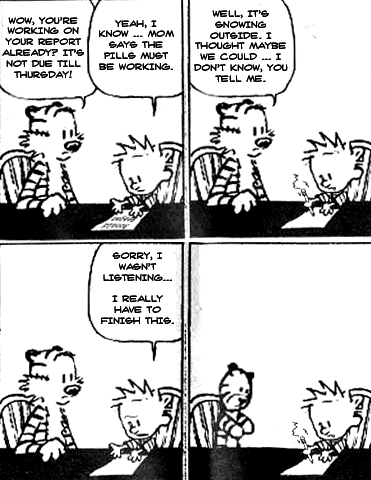
But to cheer you up, someone also posted this on MetaFilter, a link to a collection of online scans of all ten years of Calvin and Hobbes, the strip that entered syndication the day I turned five. Can you believe this December will mark the tenth year since Bill Watterson stopped drawing C&H?
Here’s a Torrent link to a PDF of all those strips (187 mb).
Soon, however, you won’t even have to turn to the glorious Intarweb to get your fix of Calvinball. The entire strip is being compiled into one giant collection, to be released in September.
A couple of years ago, an article appeared in The Cleveland Scene about Bill Watterson, his reclusiveness, his artistic integrity and his future plans. It was quite a good read (also discovered, I believe, via MetaFilter).
MetaFilter’s down at the moment I’m posting this, but when it comes back up, I’ll edit this entry.
As usual, when it comes to the Oscars, Fametracker’s got the goods: